
2026 is shaping up to be a year of consolidation and redefinition in the global automotive industry. Supply chains, affected by disruptions in recent years, are evolving toward smarter, more regional, digital, and sustainable models. Mexico, with its strategic position in North America, is positioning itself as a key player in this scenario, facing both challenges and opportunities to strengthen its competitiveness in the region.
In this context, logistics becomes a strategic factor: it no longer just connects factories with markets, but also drives competitiveness, resilience, and innovation in the sector. Below, we analyze the main logistics and automotive trends that will shape 2026, with a special focus on Mexico’s role as a key player in the transformation of mobility and global trade.
1. Nearshoring and Regionalization: The New Backbone of Trade
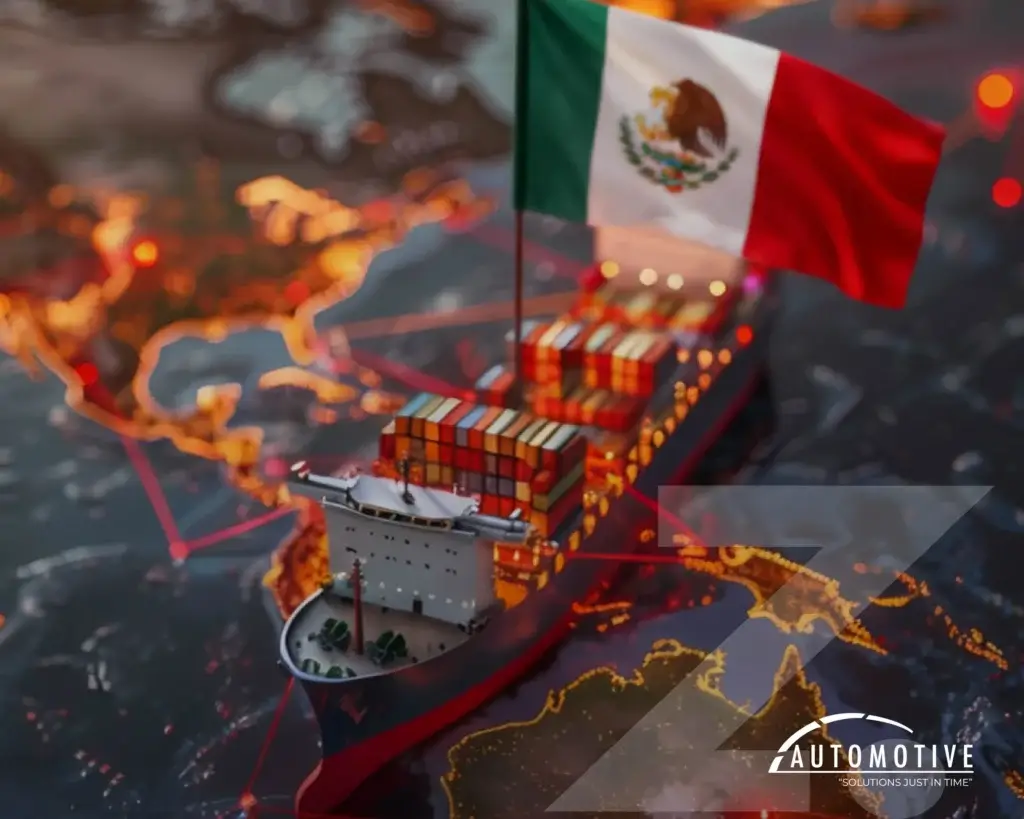
In recent years, nearshoring (the relocation of production operations closer to the end market) has gone from being a trend to becoming a structural strategy. By 2026, this movement will reach operational maturity in North America.
The relocation of production closer to consumer markets, known as nearshoring, is gaining momentum. Mexico, with its proximity to the United States and its logistics infrastructure, is benefiting from this trend, attracting investment and strengthening its role in the regional automotive supply chain.
Mexico will continue to consolidate its position as one of the continent’s main industrial and logistics hubs. Global automakers and suppliers continue to expand operations in states such as Guanajuato, Coahuila, Nuevo León, Puebla, and Querétaro, attracted by their skilled labor force, road network, and rail infrastructure. In addition, the modernization of the USMCA and incentives for the production of electric vehicles in the region will reinforce manufacturing integration. This represents a historic opportunity to strengthen the Mexico-U.S.-Canada logistics corridors.
2. Electrification and Sustainable Mobility: A structural change in production
The transition to electric vehicles (EVs) will continue to be one of the most powerful drivers of transformation. However, by 2026, the market will show signs of selective maturity: not all models will be electric, and companies will adjust their portfolios to the reality of consumption, infrastructure, and tax incentives.
While brands such as Tesla, BMW, BYD, and Ford expand their electric production, other brands are adopting a hybrid or flexible approach, maintaining combustion lines alongside EVs. This forces automotive logistics to operate in two ways, managing traditional components (engines, transmissions) alongside batteries, inverters, and highly complex electronic systems. New storage schemes with thermal and safety controls are predicted, and the requirement for certified suppliers in the handling of sensitive materials will be indispensable.
Mexico is strategically positioned: it already participates in the assembly of electric vehicles and is attracting investment for battery and auto parts plants, which will transform its logistics map in the coming years.
3. Artificial Intelligence and Comprehensive Digitization of the Supply Chain
2026 will mark the transition from analytical digitization to operational digitization.
Artificial Intelligence (AI) will not only be used to analyze data, but also to make real-time decisions within logistics operations. The integration of laser-guided vehicles (LGVs), the adoption of AI-based tools for predictive demand analysis, and the optimization of logistics routes enable more efficient resource management and reduced operating costs. These technologies are being implemented by both large companies and smaller players in the supply chain.
For example:
- Predictive demand systems that automatically adjust production orders.
- Transportation routes optimized in real time using AI and satellite traffic data.
- Digital twins that simulate the behavior of plants, warehouses, or entire networks before implementing changes.
The implementation of warehouse management systems (WMS) and enterprise resource planning (ERP) systems facilitates greater visibility and real-time control of logistics operations. This digitization improves efficiency and responsiveness to changes in demand and market conditions.
The shortage of logistics talent and increasing volumes are driving accelerated automation in distribution centers. Collaborative robots (cobots), automated picking systems, and AI-powered smart conveyors will become standard by 2026. However, this will not replace humans: logistics workers are evolving toward a technical-digital profile, capable of managing systems, analyzing data, and supervising robot operations.
The result: greater efficiency, fewer human errors, and complete visibility of the end-to-end logistics flow.
4. Automated Last Mile and the Pressure of E-Commerce
Last-mile logistics will continue to be the most dynamic and competitive link in the chain. By 2026, we will see greater adoption of autonomous delivery vehicles, drones, and urban micro-hubs that enable faster and more sustainable deliveries.
Consumers expect same-day deliveries, driving automation and collaboration between logistics operators, retailers, and municipal governments.
Courier companies are testing ground robots on industrial campuses or in controlled urban areas, and although regulation is still limited, their expansion will be gradual.
Complementary trends:
- Expansion of smart lockers and automated collection points.
- Implementation of dynamic routes that adjust to traffic, weather, and demand.
- Use of electric or hybrid vehicles for urban deliveries to comply with environmental regulations.
5. Green Logistics and Transition to Sustainable Supply Chains
Sustainability is no longer a reputational choice, but a competitive requirement.
Major manufacturers and logistics operators are adopting net-zero emissions targets for 2030–2035, which will translate into tangible measures by 2026:
- Fleet renewal towards electric or hydrogen trucks.
- Use of alternative fuels (biodiesel, compressed natural gas).
- Route optimization and load consolidation to reduce mileage.
- Design of recyclable packaging and parts return systems.
Mexico is already seeing movement in this direction: companies in the Bajío region and the north are investing in electric charging infrastructure, solar panels in industrial parks, and automotive recycling systems.
7. Resilience and Risk Management: The New Global Priority
Disruptions stemming from geopolitical conflicts, variations in energy costs, and extreme weather events will continue to affect the global supply chain.
The year 2026 will emphasize resilience strategies, which will include:
- Supplier diversification (multi-sourcing).
- Regional strategic inventories.
- Flexible logistics contracts that allow for capacity adjustments in emergencies.
- Real-time monitoring of operational and financial risks.
Mexico faces significant challenges, such as the need to strengthen its logistics infrastructure and improve training in advanced technologies. However, it also presents opportunities, such as strengthening local supply chains and adapting to the new rules of the USMCA, which could consolidate its position as a logistics hub in North America.
2026 will be a pivotal year for automotive logistics, marked by the adoption of new technologies, the reconfiguration of supply chains, and adaptation to an evolving regulatory environment. Companies that successfully integrate these trends into their operations will be better positioned to meet the challenges and seize the opportunities that arise in this dynamic sector.