
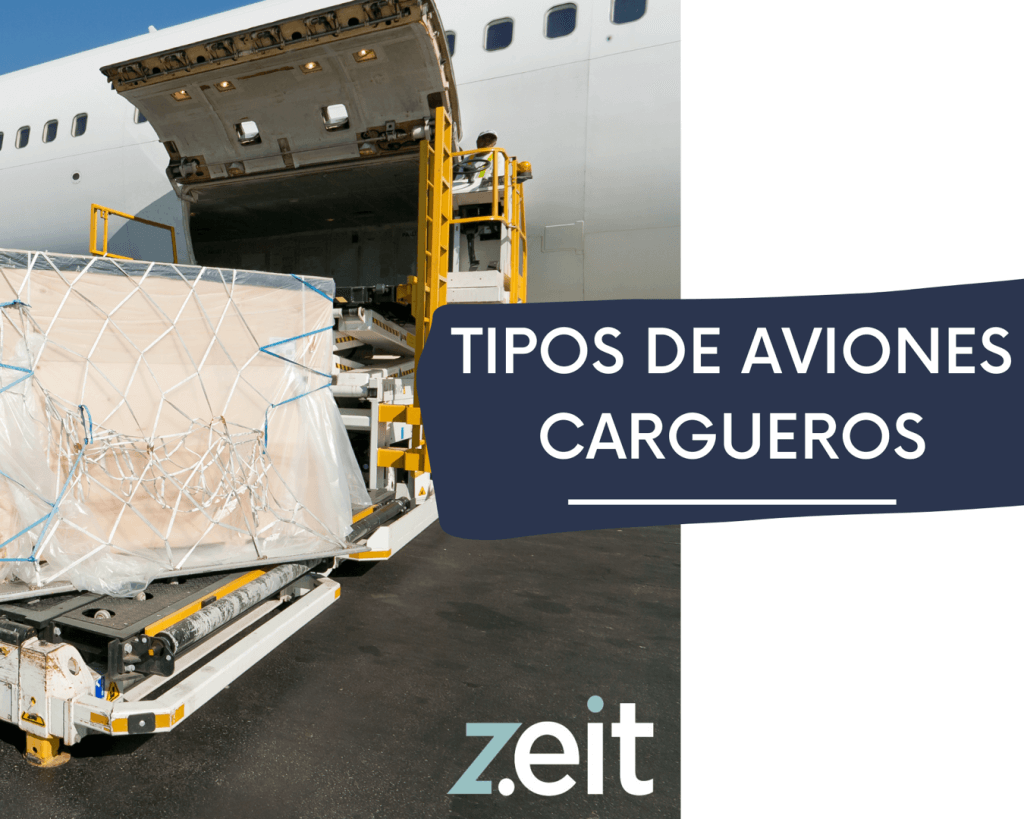
The types of aircraft used in logistics vary depending on the type of cargo they carry; broadly speaking, they can be classified into three main groups: first, aircraft that carry both passengers and cargo; second, aircraft that carry only cargo; and finally, super transport aircraft.
Mixed-use aircraft
Combined-use aircraft are those that carry both cargo and passengers. Passengers are in the cabin, and cargo is in the cargo holds.
The most commonly used are:
Airbus 330 and Airbus 340
The Airbus 340 is a passenger aircraft whose cargo hold is used to transport goods. It has four engines and a range of 12,000 to 15,000 kilometers; it features spacious cargo bays for pallets, as well as a rear bay designed for bulk cargo. In terms of cargo hold capacity, the Airbus 330 can carry up to 5 pallets plus loose cargo, while the Airbus 340 can carry up to 7 pallets. Their capacities are 10.3 metric tons and 16 metric tons, respectively.
Boeing 747
The standard Boeing 747 is one of the aircraft with the longest operational range, at 13,300 kilometers. It has cargo bays for pallets in the front and rear. To facilitate loading, it has wide doors for loading pallets or containers measuring 88” or 96” by 125”. It can carry up to 6 pallets plus loose cargo, for a total of up to 13 metric tons.
Cargo planes or freighters
Cargo planes, or freighters, are aircraft designed to transport all types of goods by air.
Among the most common are:
Boeing 747 F Freighter
The Boeing 747 F features a reinforced cabin floor, bearing no resemblance whatsoever to the standard version used for passenger transport. The aircraft is equipped with a side door or a nose door, depending on the model, and can carry a total of 38 pallets plus loose cargo, distributed between the main deck, which has a capacity of 29 pallets, and the lower deck, which holds 9 pallets and also accommodates bulk loose cargo. The total capacity is 107 metric tons.
